
Colorado Springs Thai Food, What to Order When You Want Something Lighter
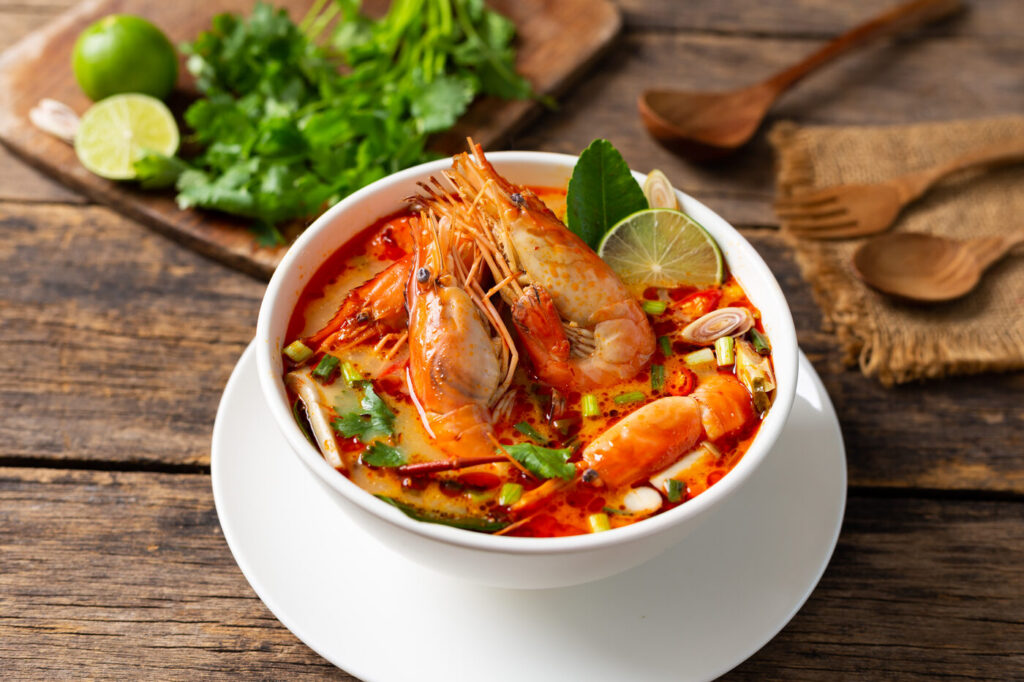
“Lighter” on a Thai menu is not a category, it is a set of choices. Three of them do almost all the work: how the dish is cooked, what the sauce or broth is built on, and what sits underneath it. Read those three things and the menu sorts itself, without anyone having to guess at a nutrition label that does not exist.
Food prepared outside the home is not an occasional thing anymore. The USDA Economic Research Service puts it plainly, noting that consumption of food prepared away from home plays an increasingly large role in the diets of U.S. consumers. When a meal out is a weekly habit rather than a special occasion, being able to read a menu properly matters more than it used to.
At Nakhon Luang Thai Kitchen, our menu runs to fifteen sections and every dish carries its ingredient line in writing. That is the useful part. We are not going to tell you what is good for you, and no restaurant menu can. What we can do is show you exactly how each dish is built, because that is the information the question actually turns on.
If you are working around something specific, contact us before you order and we will talk through what is on the plate.
What Makes One Thai Dish Lighter Than Another?
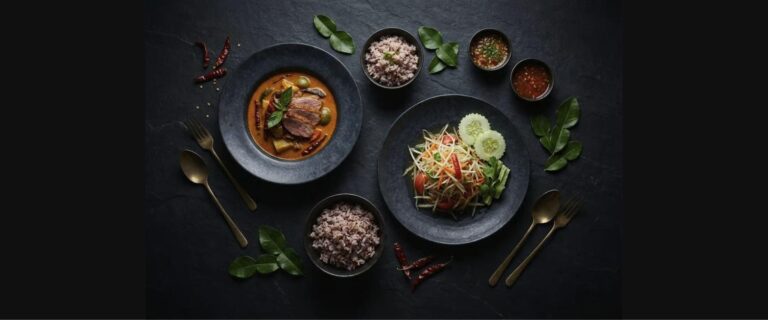
Three levers, and they are all readable from the menu before you order anything.
The first is the cooking method. Grilled and steamed dishes, and the salads that are dressed rather than cooked, sit at one end. Stir-fries sit in the middle. Anything battered, breaded or deep-fried sits at the other end. This is the single biggest difference between two dishes that otherwise share a protein.
The second is the base. A clear broth and a coconut-milk broth are two different things. Coconut milk is a fat, which is what gives a curry its body and its round finish, and it is also why the same soup reads richer in one bowl than another.
The third is what goes underneath. Rice is ordered separately on much of our menu, and Brown Rice, Steamed Rice and Sticky Rice are three different items in the Sides section. That is a decision, not a default.
None of this is a health claim, and none of it should be read as one. It is composition, printed on the menu, in the kitchen’s own words.
Which Cooking Methods Show Up on a Thai Menu?
Four, roughly, and our full Thai menu labels them clearly enough that you can sort the page in about a minute.
Grilled and Steamed
Grilled shows up more often than people expect on a Thai menu. Chicken Satay is slices of grilled chicken on a stick, marinated with Thai herbs and served with peanut sauce. Teriyaki Chicken is grilled chicken with cabbage, carrots, broccoli and green beans, served with jasmine rice.
Two of our beef salads are built on grilled beef rather than fried protein. Nam Tok Beef Salad is Isaan-style warm beef slices marinated in tamarind and lime juice with toasted rice powder, red onions, cilantro and green onion over crisp lettuce. Yum Nua Beef Salad is the Central Thai version, cold grilled beef with tomato, cucumber, celery, mint and cilantro.
On the steamed side, Pra Ram is the clearest example: steamed broccoli, carrot, green beans, mushroom, bean sprouts and spinach, topped with peanut sauce and crushed peanuts. Gyoza can be ordered steamed rather than pan-fried, and Shu-Mai is steamed as standard. Steamed Veggies is available on its own from the Sides list.
Stir-Fried
The middle of the range, and the largest part of the menu. A stir-fry uses far less oil than a deep-fryer does, and on our Entree section several of them are built around vegetables rather than around a protein.
Broccoli Stir-Fry, Mixed Vegetable Stir-Fry, Ginger Stir-Fry and Eggplant Delight all sit here. Eggplant Delight is fresh eggplant with broccoli, carrot, green beans, bell peppers, onions, cabbage, mushroom and basil leaves. Garlic Pepper Stir-Fry comes with a side of steamed carrots, broccoli, cabbage, fresh tomato and cucumber alongside it.
Battered and Deep-Fried
Worth knowing so the choice is deliberate rather than accidental. Crispy Wings, the Chicken and Vegetable Egg Rolls, Crab Rangoon, Crispy Tofu and all four tempuras are fried. So are three House Specials: Phuket Fish is breaded and deep-fried tilapia, Thai Style Orange Chicken and Crispy Chicken Basil are both batter-fried.
There is nothing wrong with any of them. The point is that “crispy”, “tempura” and “batter-fried” are printed on the menu, so nothing is hidden.
Rolled, Not Cooked
One distinction that catches people out. Fresh Spring Rolls and Chicken Egg Rolls sound like the same appetizer and are not. The egg rolls are crispy fried rolls. The Fresh Spring Rolls are shrimp, chicken, lettuce, carrots, bean sprouts, cilantro, noodles and basil leaves rolled in rice paper, served with hoisin sauce and topped with ground peanuts. No fryer involved.
Which Thai Soups Are Broth-Based and Which Are Coconut-Based?
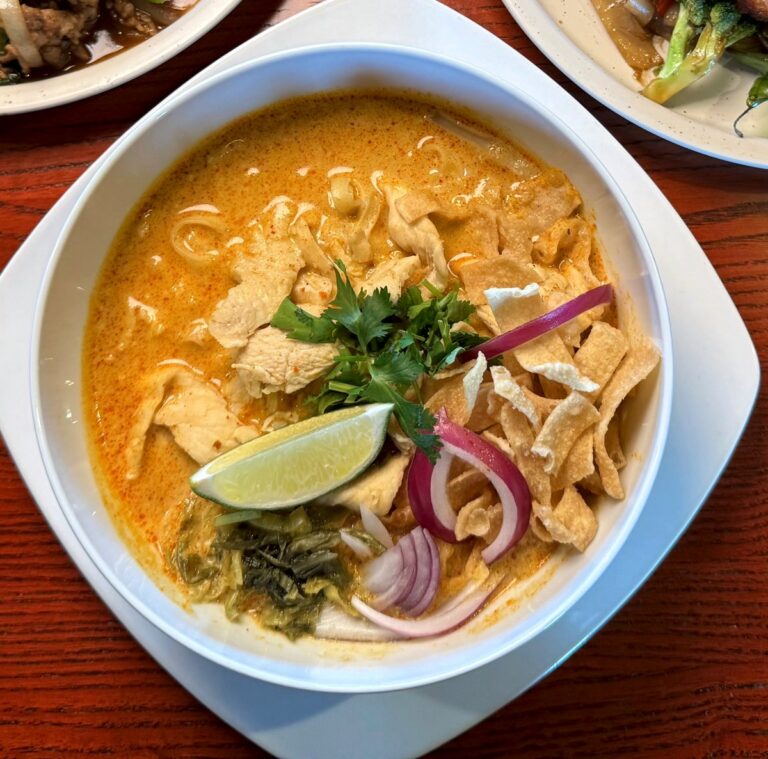
This is the cleanest split on the whole menu, and it is the one most people get wrong because the two soups sound almost identical.
Tom Yum is the clear one. Ours is a clear hot and sour broth with mushrooms, tomatoes, onions, lemongrass, galangal, kaffir lime leaves and lime juice. No coconut milk.
Tom Kha is the coconut one. Same aromatic group, mushrooms, tomatoes, onions, lemongrass, galangal, kaffir lime leaves and lime juice, but built in coconut milk instead of a clear broth. Tom Kha Seafood is the same base with shrimp, mussels, squid, fish and imitation crab meat.
Two more sit on the clear side. Wonton Soup is wontons stuffed with ground chicken, carrot and broccoli in a clear broth with green onion and garlic. Chicken Rice Soup is chicken in a clear broth topped with green onions and fried garlic.
So the rule is short: if the name has Kha in it, it is coconut. If it does not, check the ingredient line, because it is probably clear.
The same logic carries into the Curry section, where every one of the seven is finished in coconut milk or coconut sauce. If a coconut base is what you are steering away from, the curry section is not the place to look, and the stir-fry and salad sections are.
How Do You Build a Lighter Thai Order?
Four decisions, in the order you actually make them.
Start From the Vegetable-Forward Entrees
The Entree section is where the menu is most flexible. Broccoli Stir-Fry, Mixed Vegetable Stir-Fry, Ginger Stir-Fry, Eggplant Delight and Pra Ram are all built around vegetables first, with the protein as an addition rather than the centre of the plate.
Pra Ram is the outlier worth calling out, because it is the only one on that list where the vegetables are steamed rather than stir-fried. It does come topped with peanut sauce and crushed peanuts, which is a rich sauce, so if that is not what you want, that is a thing to say when you order.
Pick the Protein Deliberately
Noodle, Curry, Entree and Fried Rice all open with the same line: choice of protein. Nine options on every dish in those four sections, which are pork, tofu, mixed vegetables, chicken, beef, shrimp, salmon, combination seafood and duck.
Mixed vegetables is one of the nine. That means most of the menu can be ordered without meat in it, simply by choosing it as the protein rather than hunting for a separate section. Tofu and salmon are on the same list.
Treat the Rice as a Second Choice
Rice is its own line item in the Sides section, and there is more than one kind: Steamed Rice, Brown Rice, Sticky Rice and a Side of Fried Rice. Brown rice being on that list at all is worth knowing, because plenty of Thai menus do not carry it.
Some dishes state their rice in the description, so read the line first. Pad Pong Ka Rhee Seafood and Pad Prik Pao Seafood are both listed as served with rice, and Teriyaki Chicken comes with jasmine rice as part of the plate.
Say What You Are Working Around
Our menu asks for this directly, in its own words: please let us know of any allergy or dietary needs. Say it when you order, and say it specifically rather than generally.
We are not going to tell you a dish is safe for a particular condition from a blog post, and no menu description can carry that weight. What we can do is talk through what actually goes into a plate before it is made, which is a conversation worth having in person or on the phone rather than in an order note.
Heat is worth naming at the same time. All dishes can be made to your desired spice level, and a dish ordered gentler keeps its aromatics and loses only the chili edge.
Where to Start on Our Menu
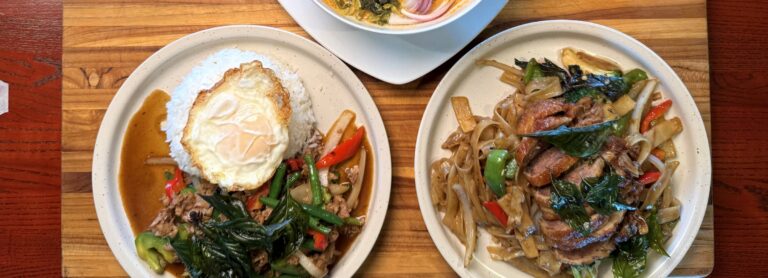
If you want one order that shows what the lighter half of this menu can do, take Tom Yum for the clear broth, a Nam Tok or Yum Nua salad for the grilled beef, and a Ginger Stir-Fry with mixed vegetables. Nothing on that plate went near a fryer, and none of it is a compromise version of something else.
If you would rather change one thing instead of everything, change the protein or change the rice. Swapping to mixed vegetables or tofu, or moving from steamed rice to brown, is a single decision at the point of ordering and it costs nothing.
Here at Nakhon Luang Thai Kitchen in Rockrimmon, our whole menu is written out with its ingredients, and the kitchen sets the heat where you ask.
Order the lighter half of the menu on our online ordering page and it is ready when you arrive, with no wait. If you want to tell us what you are working around first, we are on (719) 531-5175.
Frequently Asked Questions
What’s the healthiest thing to order at a Thai restaurant in Colorado Springs?
There is no single answer, and a restaurant menu is not the place to get one. What a menu can tell you is how each dish is cooked and what goes into it, and that is the part you can actually verify. On ours, the grilled and steamed dishes, the dressed salads and the clear-broth soups sit at one end of the range, and the battered and deep-fried items sit at the other. A Thai menu holds both, which is why the cuisine as a whole is the wrong unit to think in. Read the ingredient line under each dish instead, and if you are working around a specific dietary need, raise it with us directly rather than reading it off a description.
Which Thai soup does not have coconut milk in it?
Tom Yum. Ours is a clear hot and sour broth with mushrooms, tomatoes, onions, lemongrass, galangal, kaffir lime leaves and lime juice, and there is no coconut milk in it. Tom Kha uses the same aromatic group but is built in coconut milk, which is what makes the two taste so different despite reading almost identically on a menu. Wonton Soup and Chicken Rice Soup are also clear-broth options.
Can I order Thai food without meat?
Yes, and you do not need a separate section for it. Noodle, Curry, Entree and Fried Rice all offer a choice of protein, and mixed vegetables and tofu are two of the nine options. That means most of the dishes in those four sections can be ordered that way at the point of choosing. Some appetizers are built without meat as standard, including the Vegetable Rolls, Crispy Tofu and Kabocha Squash Tempura.
Do you have brown rice?
We do. Brown Rice sits in the Sides section alongside Steamed Rice, Sticky Rice and a Side of Fried Rice. It is worth knowing because a lot of Thai menus carry only jasmine rice. Read the dish description first though, since some plates state the rice they come with, and Teriyaki Chicken for example arrives with jasmine rice already.
Are Thai curries heavy?
Every curry on our menu is finished in coconut milk or coconut sauce, and coconut milk is a fat, so a curry has more body than a clear-broth dish by construction. Whether that reads as heavy depends on what else is on the table and what is underneath it. Curries built on potatoes and carrots, like yellow and massaman, spread the sauce across the vegetables. If a coconut base is not what you want on a given night, the stir-fry, salad and clear-soup sections are where to look instead.
What is the difference between fresh spring rolls and egg rolls?
The egg rolls are fried and the fresh spring rolls are not. Our Chicken Egg Rolls and Vegetable Rolls are crispy fried rolls with cabbage, carrots, celery and clear noodles. Fresh Spring Rolls are shrimp, chicken, lettuce, carrots, bean sprouts, cilantro, noodles and basil leaves rolled in rice paper, served with hoisin sauce and topped with ground peanuts. Same word in the name, entirely different preparation.
Can I ask for a dish with less oil or no sauce?
Ask us rather than assume. The menu invites guests to raise any allergy or dietary need, and a request about how a dish is prepared is the same kind of conversation. What is possible varies by dish, because some sauces are what hold the dish together and some are added at the end. Calling the restaurant is a better route for this than a notes field on an online order.
Does ordering mild make a dish lighter?
No, those are two separate things. Spice level changes how much chili goes in and nothing else, so a mild green curry is still built in coconut milk and a mild tempura is still battered and fried. Heat is a comfort decision. Cooking method and base are the composition decisions, and they are the ones this post is about.