
Colorado Springs Thai Dining, What to Know Before You Go
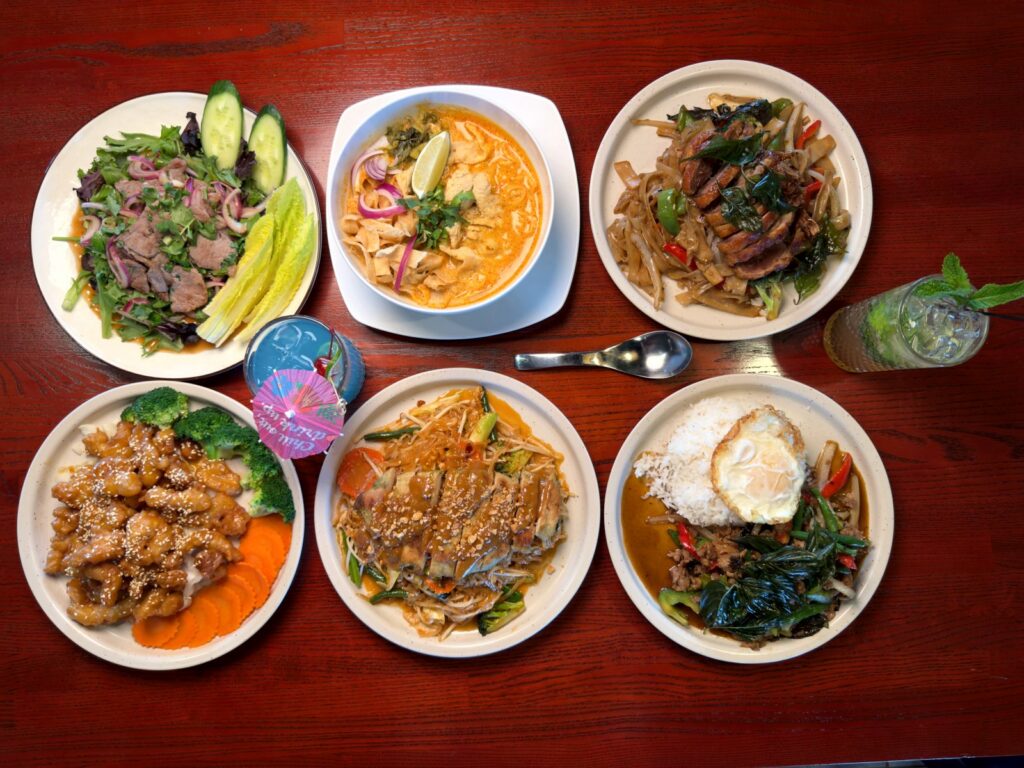
If you have ever sat down at a Thai restaurant, opened a menu with fifteen sections on it, and quietly ordered the one dish you already recognized, you are in good company. It is the most common way a first Thai meal goes, and it is also the reason a lot of people leave thinking Thai food is narrower than it is.
Dining out is not a small habit in this country. The National Restaurant Association projects industry sales of $1.55 trillion in 2026, with roughly 100,000 jobs added to bring total employment to 15.8 million. A very large number of those meals are somebody’s first visit to a cuisine they have not eaten before.
At Nakhon Luang Thai Kitchen, we field the same handful of questions at the table most weeks, and almost none of them are about which dish is best. They are about how the menu works, when the kitchen is open, and what to say if you want something adjusted. Those are answerable before you arrive.
If you would rather ask us directly, contact us for hours, directions or a quick recommendation before you come in.
The global Thai cuisine market is projected to grow from $10.43 billion in 2026 to $19.27 billion by 2034, a compound annual growth rate of 7.98 percent. Thai food is not a niche cuisine anymore, which means a growing share of the people ordering it this year are ordering it for the first time.
How Is a Thai Menu Actually Organized?
Not by heat, and not by how adventurous a dish is. A Thai menu is organized by preparation, which is why scanning it for a dish name rarely works and reading it by section almost always does.
Two different logics sit on the same page. Some sections are fixed compositions the kitchen builds a specific way. Others are formats where you choose the protein yourself. Once you can tell which is which, the whole page gets easier to read.
The Sections That Decide Your Order
Our full Thai menu runs fifteen sections: House Specials, Street Food, Appetizers, Salad, Soup, Noodle, Curry, Entree, Fried Rice, Kids Menu, Sides, Dessert, Beverages, Beer and Wine, and Cocktails.
Four of those work the same way as each other. Noodle, Curry, Entree and Fried Rice each open with the same line: choice of protein. You pick the dish, then you pick from pork, tofu, mixed vegetables, chicken, beef, shrimp, salmon, combination seafood or duck. Nine options, on every dish in those four sections.
House Specials and Street Food do not work that way. Those are set builds where the protein is part of the dish, which is why the Roasted Duck Drunken Noodles is its own item rather than the Drunken Noodles with duck selected. The two dishes are related, not identical.
That single distinction explains most of the confusion a Thai menu creates. If a dish appears in a choice-of-protein section, you are being handed a decision. If it appears in House Specials or Street Food, the kitchen has already made it.
Step 1: Check the Hours Before You Plan Around Them
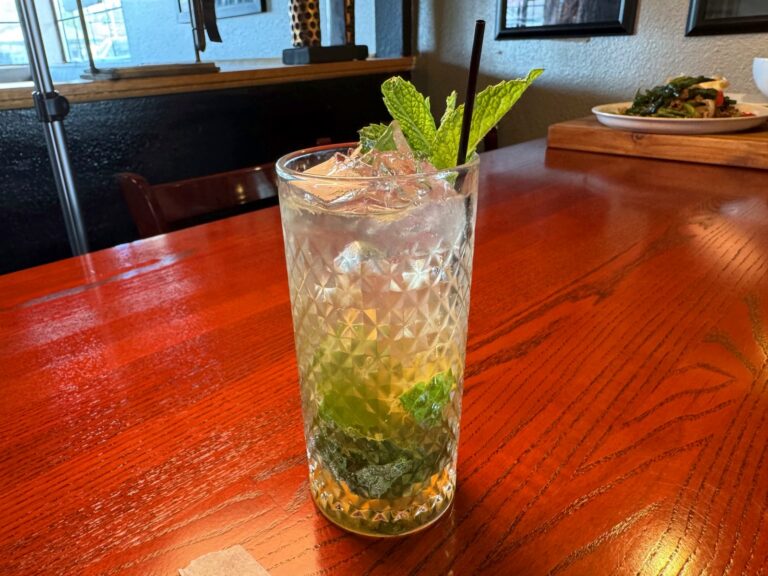
We serve daily, but not continuously. Service runs from 11:00 AM to 3:30 PM, then closes and opens again from 4:30 PM to 8:30 PM, seven days a week.
That hour in the middle catches people out. It is not a slow period, it is a closed one, and it is the single most common reason somebody arrives to a locked door on an afternoon that felt like a perfectly normal time to eat.
Two practical consequences:
- A late lunch means before 3:30 PM, not around 3:30 PM. Give yourself room.
- An early dinner means after 4:30 PM. The 3:30 to 4:30 window is when the kitchen resets between services.
Holidays can move the schedule. Our address, phone number and current hours all sit on our contact page, and that is the version to trust if you are planning around a specific date.
Step 2: Read the Menu by Section, Not by Dish Name
Scanning for something familiar is the instinct, and it is the habit that keeps most people inside the same three dishes forever. Reading by section takes about the same amount of time and gets you somewhere different.
Work down the page in this order:
- Decide the format first. Do you want noodles, a curry over rice, a stir-fry, or fried rice? That single choice removes about two thirds of the menu.
- Then read the ingredient line, not the name. The line underneath each dish is where the actual information lives. Bamboo shoots, basil, bell peppers and coconut milk tell you far more than the dish name does.
- Then pick your protein, if you are in one of the four choice-of-protein sections.
- Then check the Sides. Rice is its own decision, and Step 4 covers why.
The ingredient line is also where the difference between two similar-sounding dishes shows up. Pad Thai and Pad Se-Ew both read as stir-fried rice noodles until you notice that one is thin noodles with bean sprouts and crushed peanuts, and the other is large flat noodles with carrots and broccoli in soy sauce.
Step 3: Say Your Heat Level, and Anything You Are Working Around
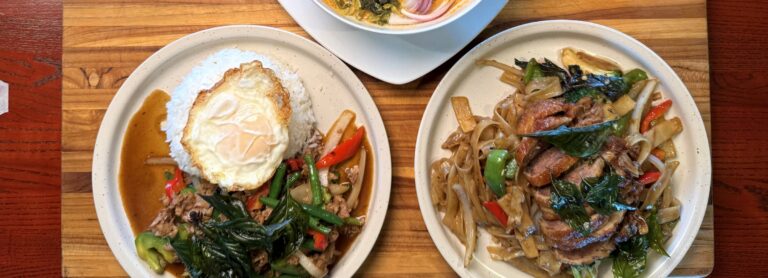
Our menu carries this line, and it is worth taking literally: all dishes can be made to your desired spice level, just let us know.
Heat in Thai cooking is not a fixed property of a dish. It is set at the point the dish is made, which means it is a request rather than a limitation. A green curry can be ordered gentle. A mild noodle plate can be ordered with real chili in it.
A few things worth knowing about how to phrase it:
- Name a level rather than a preference. “Mild” travels better than “not too spicy”, which means different things to different people.
- Order one notch below your guess if you are unsure. Chili accumulates across a meal. Adding heat at the table is easy and taking it out is not possible once the dish is cooked.
- On an online order, type it in. Nobody is standing at the table to ask. A preference that never gets written down never reaches the kitchen.
The same menu also asks guests to raise dietary needs directly: please let us know of any allergy or dietary needs. Say it when you order rather than after the plate arrives, and say it specifically. What the kitchen can do with any given request is a conversation to have with us, not something to assume from a menu description.
Step 4: Treat Rice as Its Own Decision
This is the step people skip, and it is the one that most often leaves a table short.
Some dishes state their rice in the description. Pad Pong Ka Rhee Seafood and Pad Prik Pao Seafood are both listed as served with rice. Teriyaki Chicken comes with jasmine rice as part of the plate. Read the line and you will know.
Where the description does not mention rice, the Sides section is where you add it, and there is more than one option: Steamed Rice, Brown Rice, Sticky Rice and a Side of Fried Rice all sit there as separate items.
That matters most with anything sauce-forward. A curry is built to be eaten over rice, and the rice is doing real work, absorbing the sauce and spreading the heat across the bite instead of letting it land all at once. Ordering a curry without something under it changes how the dish eats.
Sticky rice is worth calling out separately. It is a different variety with a clinging texture, and it is eaten by hand with the salads and grilled dishes rather than spooned like steamed rice.
Step 5: Order to Share, and Know the Party-Size Rule
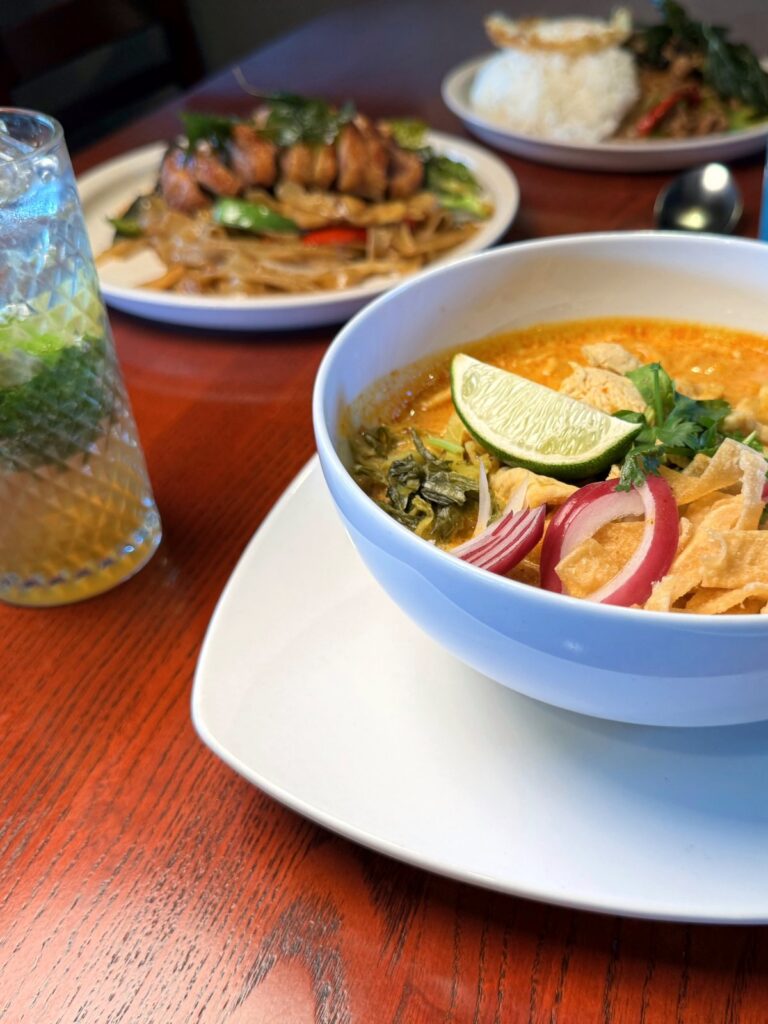
Thai meals are built around a table rather than a plate. Dishes arrive to be spread across everyone rather than assigned to one person, and the menu is designed with that in mind.
The practical version for a group:
- Spread the format, not just the flavor. One noodle dish, one curry, one stir-fry and something from the Salad or Soup section gives a table variety in texture as well as taste.
- Spread the heat. Keep one dish gentle and push another to where the chili-seekers want it. Everyone builds a plate from the middle.
- Use the Sampler Plate for a starter. Ours is ten pieces: two vegetable rolls, two chicken egg rolls, two crab rangoon, two shu-mai and two gyoza. It is the simplest way to get a table through the appetizer decision.
- There is a Kids Menu. Kid’s Pad Thai, Kid’s Pad See Ew and Kid’s Fried Rice each come with a juice box and one crab rangoon.
One policy to know before the check arrives, because it is on the menu and it surprises people who did not read the footer: a 20 percent gratuity is added to parties of 5 or more. That is not a surcharge, it is the tip, already included. Factor it in rather than adding a second one on top.
Step 6: Decide Between Dining In and Ordering Ahead
These are genuinely different experiences and they suit different evenings.
Dining in makes sense when the table is deciding together, when somebody has questions about a dish, or when you want the food arriving in courses rather than all at once. Reservations are requested through the form on our reservations page, which takes party sizes up to ten or more along with a date, a time and any special requests. Reservations are recommended and walk-ins are welcome.
Ordering ahead online suits a known order. You can read the whole menu at your own pace, set the spice level on each dish, and place everything without a back-and-forth. It is also the better route when you are ordering for a group and want time to think about the spread.
Questions are a separate channel from orders. If you want to check what is in a dish, ask about a modification beyond spice level, or sort out a private event, the phone and the email address on our contact page are the places for that. Orders themselves go through the online ordering page.
One more thing worth planning around. The Sides section is where an online order most often comes up short, because it is at the bottom of the page and easy to scroll past once the mains are chosen. Rice, Steamed Veggies, Peanut Sauce and Side Curry Sauce all live there. Check it before you check out rather than after, since a curry that arrives without rice under it is a different meal from the one you meant to order.
Plan the Visit, Then Let the Kitchen Do the Rest
None of this is complicated. Know when we are actually open, read the menu by section, say your heat level out loud, order rice deliberately, spread the table, and pick the format that fits your evening. Six things, and they cover almost every question we get asked at the table.
What they buy you is the freedom to order something you have not had before without it being a gamble. That is the whole point. A menu that runs from Bangkok street food to Northern noodle soups is only useful if you feel able to move around inside it.
Here at Nakhon Luang Thai Kitchen, we are on the north side of the city at 805 Village Center Drive in Rockrimmon, open daily for lunch and dinner.
Place your first order on our online ordering page with the menu in front of you and skip the line when you come to collect it. If you want to bring a question to us first, we are on (719) 531-5175.
Frequently Asked Questions About Dining at a Thai Restaurant
What should I know before eating at a Thai restaurant in Colorado Springs?
Six things cover almost all of it: the hours, including the closed hour between lunch and dinner, how the menu is organized by preparation rather than by heat, that you set your own spice level, that rice is often a separate order, that a Thai table is built to be shared, and whether you want to dine in or order ahead. Each one is a decision you can make before you arrive.
What time does lunch service end?
Lunch runs from 11:00 AM to 3:30 PM, seven days a week. Dinner service opens again at 4:30 PM, so the hour between the two is a closed window rather than a quiet one. Plan a late lunch for before 3:30 PM rather than around it.
Do I need a reservation?
Reservations are recommended and walk-ins are welcome. You can request one through the form on our reservations page, which asks for a date, a time, a party size up to ten or more and any special requests. Private events are available as well.
Can I ask for a dish to be made mild?
Yes. Our menu states that all dishes can be made to your desired spice level, so it applies across the menu rather than to a short list of dishes. Name a level when you order, and type it into the notes if you are ordering online.
Is there a kids menu?
There is. Kid’s Pad Thai, Kid’s Pad See Ew and Kid’s Fried Rice are each served with a juice box and one crab rangoon. They are the same familiar noodle and rice formats as the main menu, built for a smaller plate.
Is gratuity added automatically for a group?
A 20 percent gratuity is added to parties of 5 or more, and it is printed at the bottom of the menu. It is the tip rather than an extra service charge, so there is no need to add a second one. For parties of four or fewer, nothing is added.